

Welcome to this fascinating journey into the past, where we explore how artificial intelligence (AI) is revolutionizing our understanding of ancient texts. Imagine uncovering secrets hidden for millennia, deciphering languages long forgotten, and rewriting history as we know it. This article delves into the exciting world of AI and its impact on papyrology and ancient history. Join us as we unveil the mysteries of the past with the help of cutting-edge technology.
From the ashes of Vesuvius to the archives of ancient Korea, AI is revolutionizing our understanding of the past.
Imagine an ancient papyrus scroll, its yellowed surface bearing AI-generated text in crisp, black hieratic-like symbols, unfurled on a smooth, modern workspace. The scroll is held in place by sleek, metallic AI tools—a juxtaposition of the ancient and the futuristic. A nearby state-of-the-art stylus and digital magnifying glass share space with historical artifacts: an antique inkwell, a vintage quill, and a worn Roman stylus. The scene is a harmonious blend of history and technology, a testament to human innovation across millennia.
The AI-generated text on the scroll is a seamless amalgamation of ancient wisdom and modern algorithmic prowess. Surrounding the scroll are both cutting-edge AI devices and historical writing instruments, each contributing to the unique ambiance. A contemporary AI tablet displaying predictive text algorithms sits beside an ancient abacus, emphasizing the evolution of computation. Meanwhile, a historic wax tablet and a modern AI smart pen rest side by side, symbolizing the enduring human desire to record and communicate ideas, regardless of the tools available.
The Vesuvius Challenge: Unveiling the Past
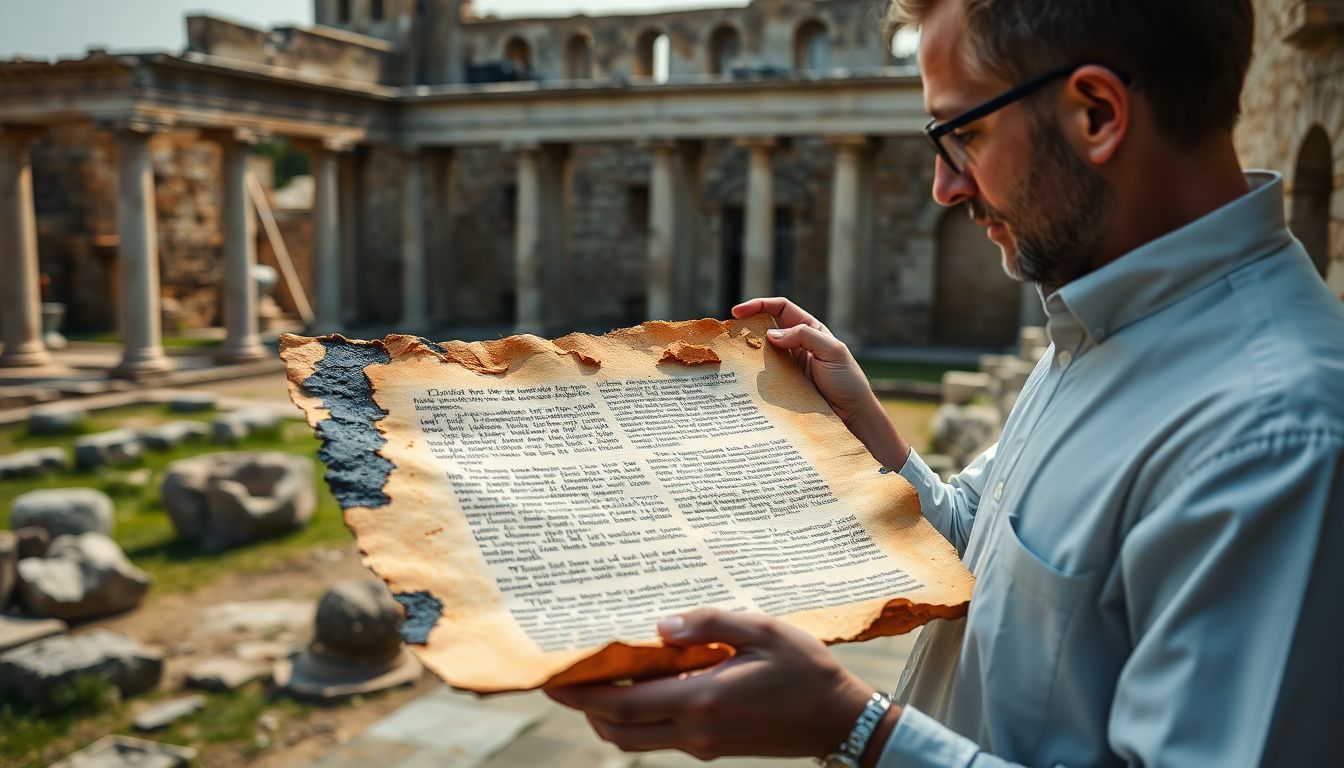
The Vesuvius Challenge project, a groundbreaking initiative led by the University of Kentucky, has made significant strides in the field of papyrology with its innovative use of AI techniques to decipher texts from charred papyrus scrolls recovered from Herculaneum. The scrolls, carbonized by the eruption of Mount Vesuvius in 79 AD, have long been considered unreadable due to their fragile state. The project employs advanced machine learning algorithms and computer vision to virtually ‘unwind’ the scrolls and reveal the hidden text. This approach involves training AI models on images of the scrolls’ surfaces, allowing the system to detect and interpret the ink traces that are invisible to the naked eye. The AI techniques used include deep learning for pattern recognition and natural language processing to contextualize the revealed text. The success of these methods has been nothing short of remarkable, offering a non-invasive alternative to traditional, destructive techniques.
The significance of the Vesuvius Challenge for papyrology cannot be overstated. The discipline, which focuses on the study of ancient texts written on papyrus, has long been hampered by the inaccessibility of damaged or deteriorated manuscripts. By enabling scholars to read texts that were previously considered lost, AI is opening up new avenues for historical and literary research. The project has already yielded exciting results, with fragments of philosophical texts attributed to the ancient Greek philosopher Philo being recovered. These discoveries are not only expanding our knowledge of ancient philosophy but also providing insights into the cultural and intellectual life of the ancient world. Furthermore, the interdisciplinary nature of the project, combining classical studies with cutting-edge technology, serves as a model for future collaborations between the humanities and sciences.
The emotional impact of the Vesuvius Challenge on researchers like Federica Nicolardi, a papyrologist at the University of Naples Federico II, is profound. After decades of painstaking work using traditional methods, the ability to read even small portions of the scrolls is a deeply moving experience. Nicolardi has expressed her joy and disbelief at seeing words emerge from the charred papyrus, describing the moment as ‘miraculous.’ The project’s success underscores the potential for AI to revolutionize fields like papyrology, where the delicate nature of the materials has historically posed significant barriers to research. However, it is crucial to remain aware of the limitations and ethical considerations involved in AI applications. These include the need for careful validation of AI-generated interpretations, concerns about data privacy and ownership, and the importance of preserving the integrity of the original artifacts.
- Positives:
- Non-invasive technique for reading fragile texts
- Potential for significant historical and literary discoveries
- Interdisciplinary collaboration between humanities and sciences
- Negatives:
- Potential for misinterpretation of AI-generated data
- Ethical considerations regarding data privacy and ownership
- Need for careful validation and preservation of original artifacts
AI in Ancient Texts: From Greece to China
AI has emerged as a powerful tool for historians and linguists, revolutionizing the way we approach ancient texts. From the classical languages of Greek and Latin to the enigmatic Oracle Bone Script of ancient China, machine learning algorithms are being employed to decode and interpret texts that have long puzzled scholars. One of the most notable examples is the use of AI in deciphering the Herculaneum Papyri, a collection of philosophical texts preserved by the eruption of Mount Vesuvius. These scrolls, carbonized and fragile, have been notoriously difficult to read, but AI-driven imaging techniques and deep learning models have made significant strides in revealing their contents.
Neural networks, in particular, have proven invaluable in filling in missing characters and reconstructing damaged texts. Projects like the Oxyrhynchus Papyri Project utilize convolutional neural networks (CNNs) to identify and complete fragmented papyri. These networks can learn from existing text samples and predict missing elements with remarkable accuracy. Additionally, AI is playing a crucial role in decoding lost languages, such as Linear A, a script used by the Minoans of ancient Crete. By analyzing patterns and frequencies in the text, AI models can generate hypotheses about the language’s structure and meaning. However, it is important to note that these technologies are not without their limitations. The accuracy of AI predictions relies heavily on the quality and quantity of available data, and interpretations must still be scrutinized by human experts.
Several projects have already made substantial impacts on historical research. For instance, the Electronic Archive of Greek and Latin Epigraphy (EAGLE) employs AI to digitize and analyze inscriptions, making them accessible to a wider audience and facilitating new research. Similarly, the Cuneiform Digital Library Initiative (CDLI) uses machine learning to catalog and translate tens of thousands of cuneiform texts from the ancient Near East. These initiatives not only accelerate the pace of research but also democratize access to historical documents. However, there are ethical considerations and potential pitfalls to consider:
- Over-reliance on AI could lead to a devaluation of traditional linguistic and historical methodologies.
- AI interpretations could inadvertently introduce bias or misinterpretations if not carefully vetted.
- The digital divide could exacerbate inequalities in access to these technologies and the knowledge they generate.
In conclusion, while AI offers transformative potential for deciphering ancient texts, it is essential to approach its use with a critical eye, ensuring that it augments rather than replaces human expertise.

Transforming Historical Research with AI
AI tools are revolutionizing the way scholars approach and interpret ancient sources, offering unprecedented insights and raising new questions that were previously unattainable. Through machine learning algorithms and natural language processing (NLP), AI can analyze vast amounts of textual data, identifying patterns, and making predictions that would be impossible manually. For instance, the Ithaca project, developed by researchers from DeepMind and the University of Oxford, uses AI to help restore damaged inscriptions from ancient Greece. By training the model on a large dataset of existing inscriptions, Ithaca can predict missing letters and words with remarkable accuracy, providing scholars with a powerful tool for deciphering fragmented texts.
One of the most significant advantages of AI in this domain is its ability to handle vast archives with ease. AI models can sift through thousands of documents in multiple languages, transcending the limitations of human scholars who may only be proficient in a few languages. A notable example is the work done on the Korean historical archives, where AI was employed to digitize and analyze over 100 million pages of historical documents. By recognizing multiple languages, including Classical Chinese and various Korean scripts, AI facilitated a comprehensive search and analysis of these archives, enabling scholars to uncover hidden narratives and make interdisciplinary connections.
However, while the potential of AI is immense, it is not without its challenges and limitations. Some key concerns include:
-
Data Quality and Bias:
AI models are only as good as the data they are trained on. Incomplete or biased datasets can lead to skewed results, potentially reinforcing existing biases or creating new ones.
-
Interpretability:
AI-generated predictions and insights often lack clear explanations, making it difficult for scholars to understand the reasoning behind certain conclusions. This ‘black box’ problem can be a significant hurdle in academic contexts where transparency is crucial.
-
Contextual Understanding:
While AI excels at pattern recognition, it may struggle with understanding the nuanced context of historical documents, which requires cultural and historical knowledge that machines currently lack.
Despite these challenges, the integration of AI in scholarly research is undeniably transformative, pushing the boundaries of what is possible and opening up new avenues for exploration and discovery.
