
Welcome to a fascinating exploration of how artificial intelligence and algorithms are revolutionizing the music industry. This article delves into the transformative impact of AI on music creation, discovery, and journalism. Join us as we navigate through the shifting landscapes of music media, the influence of algorithms on listening habits, and the potential of AI-generated music to disrupt the industry.
From Music Journalism to AI-Generated Tunes: A Deep Dive into the Future of Music
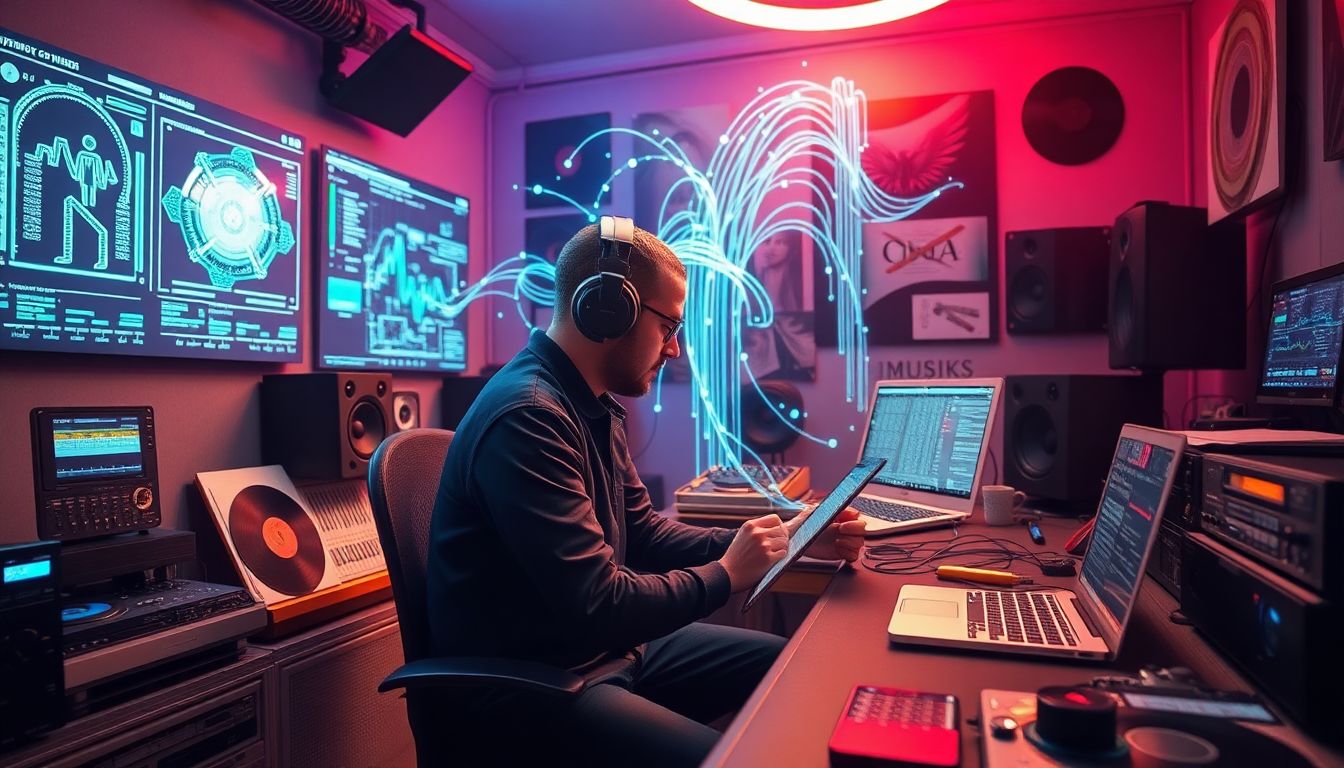
Imagine stepping into a futuristic music studio, where the air is filled with the hum of creativity and the blur of technological innovation. The walls are adorned with AI interfaces, their screens pulsating with algorithms visualized as flowing data streams, akin to rivers of sound and color that dance and intertwine. These algorithms are not just passive tools, but active participants in the creative process, learning and adapting to the musician’s style and preferences in real-time. They suggest melodies, harmonies, and even lyrics, pushing the boundaries of human-AI collaboration.
In the midst of this digital symphony, a journalist sits typing on a laptop, chronicling the evolution of music in the age of AI. The laptop’s screen reflects the journalist’s fascination, surrounded by a sea of vinyl records and digital music players, each a testament to the past, present, and future of sound. The room is a harmonious blend of analog and digital, a physical manifestation of the music industry’s transformation, where AI is not replacing human creativity, but augmenting it, creating a new harmony between person and machine.

The Evolution of Music Journalism
In recent years, music journalism has undergone significant transformations, one of the most notable being the acquisition of Pitchfork by media conglomerate Condé Nast in 2015. This shift has sparked conversations about the future of music criticism, with some arguing that the independence and authenticity of Pitchfork’s voice could be compromised within a corporate structure. The acquisition has led to increased resources and exposure for Pitchfork, but it has also raised questions about the potential homogenization of music criticism under a mainstream media umbrella.
Critic and author Ann Powers has emphasized the importance of distinctive voices in music journalism, suggesting that the field thrives on the diversity of perspectives and unique insights. She argues that music criticism should reflect the vast spectrum of experiences and identities within the music world. However, the rise of AI in music journalism presents both opportunities and challenges. While AI could help in analyzing vast amounts of data and predicting trends, it also risks flattening the nuanced human experiences and insights that Powers highlights. Furthermore, AI could exacerbate the homogenization trend by favoring algorithms over individual voices, leading to a potential loss of the rich tapestry of opinions that have traditionally defined music criticism.
- Pros of AI: Data analysis, trend prediction, efficiency.
- Cons of AI: Potential loss of nuanced human insights, risk of homogenization.
Algorithms and Music Discovery
In the contemporary digital landscape, algorithms have emerged as powerful arbiters of musical taste, significantly transforming how people discover and listen to music. Streaming platforms like Spotify employ complex algorithms to analyze listening habits, suggesting new tracks and artists tailored to individual preferences. These algorithms, driven by machine learning, sift through vast libraries of music to curate personalized playlists, thereby democratizing access to an unprecedented variety of genres and artists. This approach has led to the discovery of lesser-known musicians and facilitated a more diverse musical ecosystem. However, it’s crucial to examine the multifaceted impact of these algorithmic recommendations.
Critic Kyle Chayka offers a nuanced perspective on the drawbacks of algorithm-driven music platforms. Chayka argues that while algorithms excel in predicting what listeners might enjoy based on past behavior, they can inadvertently create echo chambers, limiting exposure to new and different types of music. This phenomenon can homogenize musical tastes, potentially stifling the serendipitous discovery of eclectic sounds. Additionally, Chayka points out that algorithms may prioritize certain tracks or artists based on commercial interests, leading to a skewed representation of the musical landscape. Furthermore, the role of AI in enhancing or hindering the music listening experience is a contentious issue. On one hand, AI can generate novel compositions and assist in music production, opening new creative avenues. Conversely, an over-reliance on AI could diminish the human touch that makes music emotionally resonant, raising questions about authenticity and originality. The debate underscores the need for a balanced approach, where algorithms complement rather than dictate musical exploration.

AI-Generated Music: The Next Big Thing?
AI music generators present a tantalizing potential to revolutionize the music industry, offering unprecedented possibilities for creation, collaboration, and consumption. These tools, powered by advanced algorithms and machine learning models, can analyze vast amounts of musical data to generate new compositions, mimic styles, and even create entirely new genres. Mark Henry Phillips, a renowned composer and podcast producer, has suggested that AI could fundamentally change music production and composition by automating certain aspects of the creative process, allowing artists to explore new sonic territories more efficiently. Phillips argues that AI could serve as a powerful augmentation to human creativity, rather than a replacement, by handling tasks such as basic arrangement, instrumentation, and even lyric generation. This could free up artists to focus on higher-level creative decisions, such as emotional narrative and aesthetic direction.
However, the integration of AI in music production also raises significant ethical and creative implications. One of the primary concerns is the issue of authorship and ownership. If an AI generates a substantial portion of a song, who should be credited as the creator? Is it the person who trained the AI model, the individual who initiated the generation process, or the AI itself? Furthermore, there are questions about the potential for cultural appropriation and homogenization. AI models trained on vast datasets of existing music could inadvertently perpetuate biases or blend cultural styles in ways that are insensitive or inauthentic. Additionally, the reliance on AI could lead to a homogenization of sound, where music begins to sound increasingly similar as algorithms optimize for popularity rather than originality. To navigate these challenges, it is crucial for the music industry to engage in open dialogues about the responsible use of AI, ensuring that this powerful technology is harnessed in a way that respects artistic integrity, cultural diversity, and ethical standards. Some key points to consider include:
- Establishing clear guidelines for AI-generated music credits and royalties
- Encouraging transparency in AI model training and data sourcing
- Promoting diversity and inclusivity in AI development and deployment
FAQ
How is AI changing music journalism?
What are the drawbacks of algorithm-driven music platforms?
How can AI enhance the music listening experience?
What are the potential benefits of AI-generated music?
- Increased creativity and innovation in music composition
- Efficient production of background music for various media
- New opportunities for collaboration between human artists and AI
.
What are the ethical implications of AI in the music industry?
- Questions of authorship and ownership of AI-generated music
- Potential job displacement for human musicians and producers
- Concerns about the authenticity and emotional resonance of AI-created music
.
