

Welcome to our detailed exploration of the future of AI regulation! In this article, we’ll dive into the proposed laws and frameworks that could shape global AI regulation by 2025. Buckle up as we journey through the complexities and innovations that await us in this rapidly evolving field.
Navigating the Future of Artificial Intelligence Governance
Imagine a skyline punctuated by towering spires of glass and steel, each a smart building operating on a central AI brain, optimizing energy consumption, waste management, and resident comfort in real-time. The air is filled with the hum of drones, each a miniature courier driven by AI, delivering everything from parcels to pizzas, while below, driverless vehicles navigate the streets with fluid efficiency, their AI systems communicating seamlessly to avoid congestion and ensure smooth traffic flow.
Pedestrians traverse the cityscape, their paths illuminated by intelligent streetlights that brighten and dim as needed, conserving energy while maintaining safety. Each person is accompanied by an invisible companion, an AI assistant that whispers in their ear, providing directions, updates on local events, and personalized recommendations for everything from restaurants to retail sales.
In this futuristic urban jungle, AI is the lifeblood, the invisible force that keeps the city moving, breathing, and growing. It’s in the gardens that bloom with plants nurtured by AI-driven precision agriculture, in the schools where AI tutors personalize education for each student, and in the hospitals where AI diagnosticians assist doctors, flagging potential issues and suggesting treatment plans. This is not a city of cold, metallic efficiency, but a vibrant tapestry of life, where AI and humans coexist and collaborate, creating a symphony of progress and innovation.

The Current State of AI Regulation
The current landscape of AI regulation is a complex tapestry of initiatives and challenges, reflecting the global struggle to balance innovation with ethical considerations and societal well-being. Governments and organizations worldwide are grappling with the rapid advancement of AI, which has outpaced the development of regulatory frameworks. Key initiatives include the European Union’s AI Act, proposed in April 2021, which aims to establish a robust regulatory framework for AI by categorizing applications based on risk levels. Similarly, the United States has introduced the AI in Government Act, designed to promote AI adoption within federal agencies while ensuring ethical and responsible use.
One of the primary challenges in AI regulation is the need for international cooperation. AI transcends geographical boundaries, making it difficult for any single government to effectively regulate its use. Organizations like the OECD and the Council of Europe have emphasized the importance of global collaboration, with the OECD’s Principles on Artificial Intelligence serving as a foundational guide for ethical AI development. However, aligning diverse national interests and legal frameworks remains a significant hurdle.
Moreover, AI regulation faces several intrinsic challenges:
- Definitional Ambiguity: The lack of a clear, universally accepted definition of AI makes it difficult to create precise regulations.
- Rapid Technological Change: The swift pace of AI advancements can render regulations obsolete quickly, requiring constant updates and adaptations.
- Balancing Innovation and Control: Regulators must walk a fine line between fostering AI innovation and implementing controls to prevent misuse.
- Data Governance: Effective AI regulation is intrinsically linked to robust data governance, ensuring data privacy, security, and ethical use.
These challenges underscore the delicate balance that governments and organizations must strike in regulating AI, emphasizing the need for adaptable, forward-thinking strategies.
Emerging Frameworks and Proposed Laws
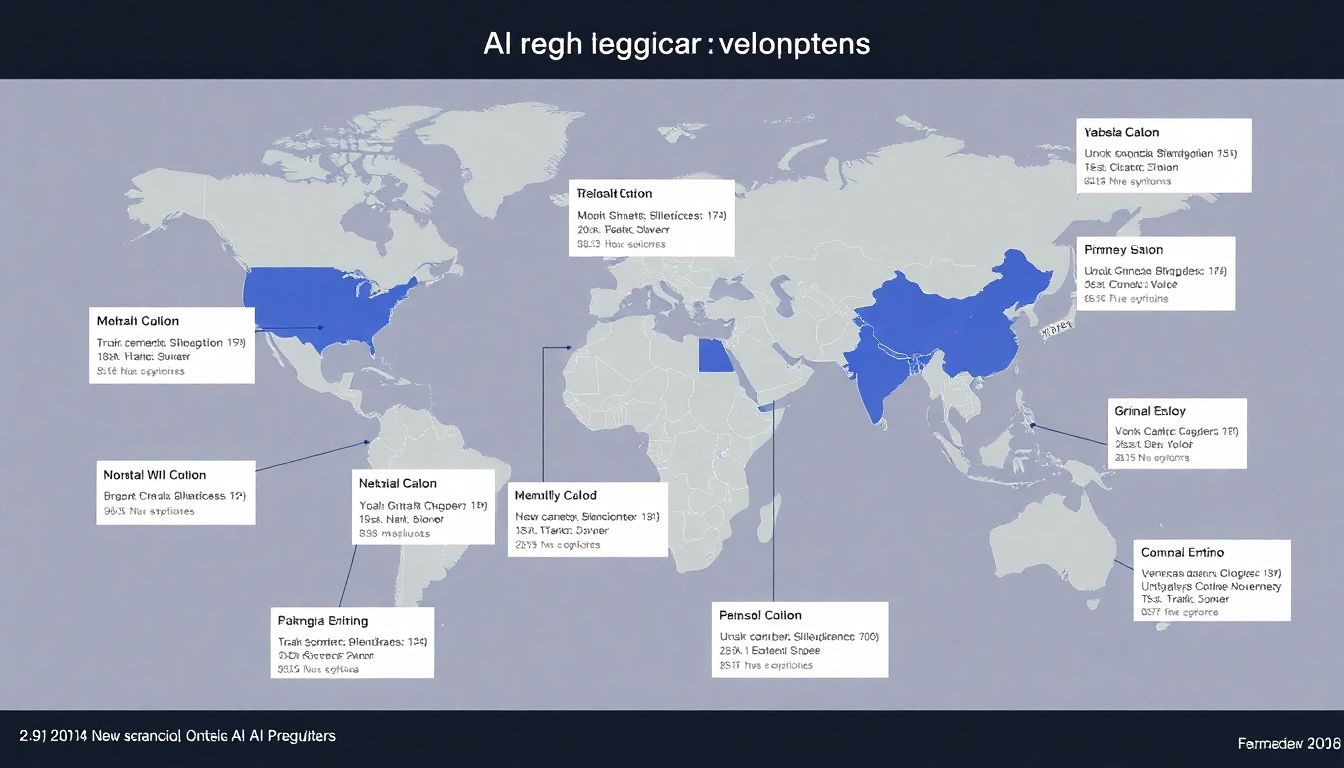
The global landscape of AI regulation is rapidly evolving, with numerous frameworks and proposed laws emerging to shape its future by 2025. Regional and international efforts are coalescing to address the complex ethical, societal, and security challenges posed by AI. Among the most notable regional initiatives is the European Union’s AI Act, proposed in 2021, which aims to create a robust regulatory framework to ensure that AI systems are safe, transparent, and respectful of fundamental rights.
At the international level, several organizations are actively working on guidelines and standards for AI governance. The Organisation for Economic Co-operation and Development (OECD) has developed principles on AI that emphasize inclusive growth, sustainable development, and well-being. Similarly, the Group of Twenty (G20) has endorsed AI principles that focus on human-centered values, transparency, and accountability. Additionally, the Council of Europe is drafting a convention on AI, which could become the first legally binding international treaty on AI regulation.
Concurrently, several countries are implementing their own national strategies and regulations to govern AI. For instance:
- The United States has introduced the AI Bill of Rights, focusing on protecting civil rights and liberties in the age of AI.
- China has issued ethical guidelines for AI, emphasizing responsible development and deployment.
- Canada is developing an AI and Data Act to promote responsible AI innovation and protect biometric and genetic data.
These collective efforts reflect a growing consensus on the need for comprehensive AI regulation, although the specific approaches and priorities may vary across regions and countries.

The Role of Ethics and Human Rights in AI Regulation
The rapid advancement of artificial intelligence (AI) has brought to the forefront the critical importance of ethics and human rights in its regulation. As AI systems increasingly permeate societies, they have the potential to exacerbate existing inequalities, infringe upon privacy rights, and introduce bias and discrimination at an unprecedented scale. Ethical considerations and human rights principles are not merely abstract concepts in this context; they are fundamental to ensuring that AI is developed and deployed responsibly. Key ethical concerns include accountability, transparency, and fairness, which are essential for building public trust in AI technologies.
To integrate these principles into AI regulation, governments and international organizations are proposing laws and frameworks that prioritize ethical and human rights considerations. For instance, the European Union’s proposed Artificial Intelligence Act aims to classify AI systems based on their level of risk, with stricter requirements for high-risk applications. This approach ensures that AI systems are subject to appropriate oversight and transparency measures, proportional to their potential impact on human rights. Additionally, the Council of Europe’s Recommendation on the human rights impacts of algorithmic systems emphasizes the need for human rights impact assessments, thereby promoting accountability and safeguarding individual rights.
Several key principles are being embedded into these proposed laws and frameworks to ensure ethical AI development and deployment:
- Human Agency and Oversight: Ensuring that AI systems are designed to augment and complement human decision-making, rather than replace it.
- Robustness, Security, and Safety: Implementing measures to mitigate risks and prevent harm throughout the AI system’s lifecycle.
- Privacy and Data Governance: Establishing robust data protection measures to safeguard user privacy and ensure responsible data management.
- Transparency: Promoting explainability and traceability in AI systems to facilitate accountability and public trust.
- Diversity, Non-discrimination, and Fairness: Addressing and mitigating unfair bias, ensuring that AI systems are developed and used in a manner that respects the principles of non-discrimination and the diversity of human experiences.
- Societal and Environmental Well-being: Considering the broader impacts of AI on society and the environment, and promoting sustainability in AI development.
- Accountability: Establishing clear responsibility and liability for AI systems and their outcomes, ensuring that those involved in AI development and deployment are answerable for their actions.
FAQ
What are the main challenges in implementing global AI regulation?
- Differing national priorities and legal systems.
- Rapid technological advancements outpacing regulatory developments.
- Balancing innovation with ethical considerations.
How are different regions approaching AI regulation?
- Europe is focusing on comprehensive frameworks like the AI Act.
- The United States is emphasizing sector-specific regulations.
- Asia is prioritizing national strategies and guidelines.
What role do international organizations play in AI regulation?
- Providing guidelines and best practices.
- Facilitating global cooperation and dialogue.
- Promoting ethical standards and human rights.
How can ethics be integrated into AI regulation?
- Including ethical considerations in the design and development of AI systems.
- Establishing ethical review boards and guidelines.
- Promoting transparency and accountability in AI decision-making.
What are the potential benefits of effective AI regulation?
- Enhancing public trust and confidence in AI technologies.
- Promoting fairness, transparency, and accountability.
- Fostering innovation and economic growth.
