

Welcome to our exploration of artificial intelligence in 2024! In this article, we’ll delve into the groundbreaking advancements that have shaped our lives this year and take a playful peek into what the future might hold. Buckle up as we journey through self-driving cars, mind-blowing text-to-video models, and the incredible strides in AI reasoning. Let’s dive in!
From self-driving cars to text-to-video models, AI has revolutionized our world. Here’s a look at the highlights of 2024 and a glimpse into the future.
Imagine a sprawling metropolis in the not-so-distant future, where the once familiar hum of internal combustion engines is replaced by the whisper-quiet purr of electric motors. Self-driving cars, sleek and aerodynamic, glide effortlessly along the city’s arteries, their advanced sensors and AI-driven algorithms navigating the urban labyrinth with precision. These autonomous vehicles, a symphony of efficiency and safety, communicate seamlessly with one another and the city’s infrastructure, orchestrating a ballet of motion that drastically reduces traffic congestion and accidents.
Amidst this bustling scene, robots of all shapes and sizes diligently perform a myriad of tasks. Humanoid robots, equipped with advanced AI and machine learning capabilities, assist in retail stores, provide guidance at information kiosks, and even tend to the city’s green spaces. Meanwhile, smaller, specialized bots clean streets, maintain public facilities, and ensure the smooth operation of the city’s utilities. These robotic workers, tireless and precise, free up human residents to pursue more creative and strategic endeavors, fostering a culture of innovation and leisure.
The backdrop of this futuristic cityscape is a tapestry of advanced AI interfaces, woven into the very fabric of the urban environment. Holographic billboards, dynamic and interactive, display real-time information and personalized content tailored to each passerby. Buildings, their smart facades shimmering with data and visualizations, communicate energy usage, occupancy, and other vital statistics to the city’s central AI, which optimizes resource allocation and sustainability. Meanwhile, citizens interact with the city’s AI through wearable devices and augmented reality interfaces, their every need and desire anticipated and met with unprecedented efficiency.
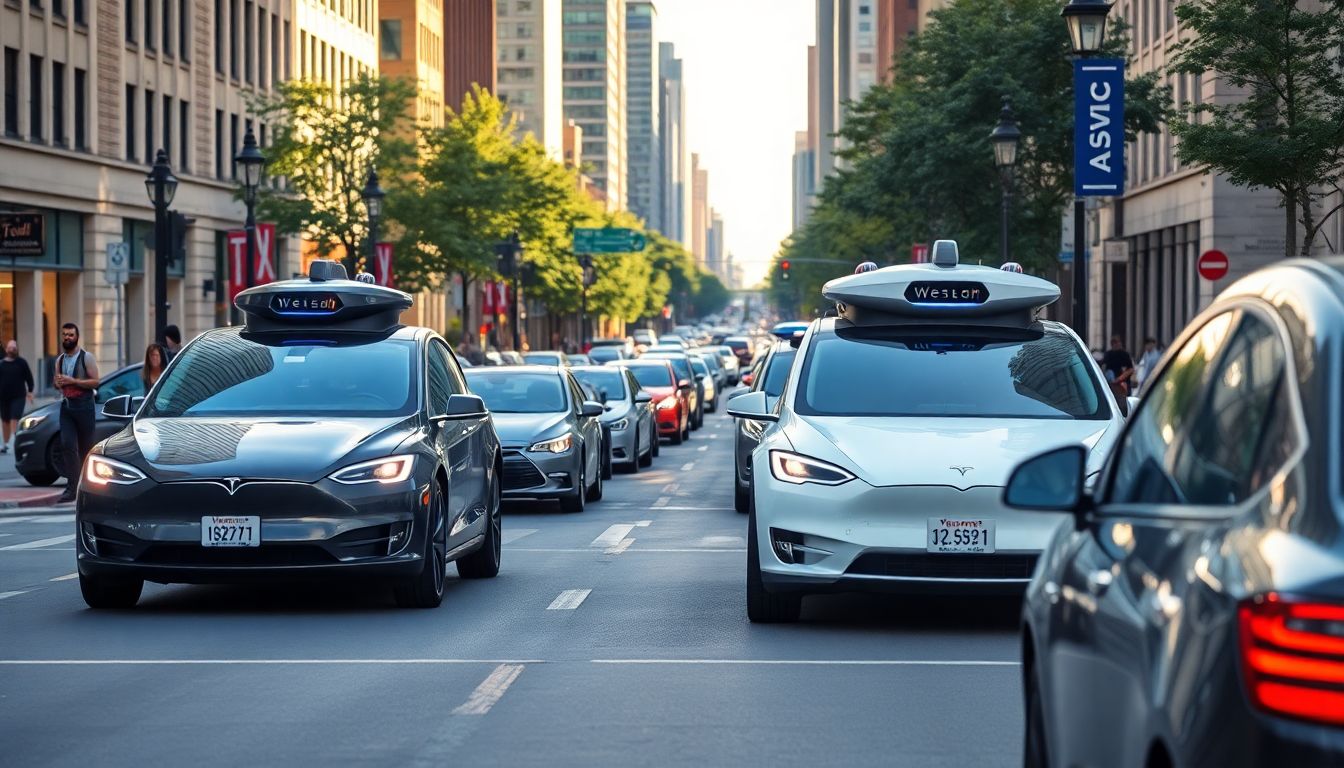
The Year of Self-Driving Cars
The year 2024 has witnessed significant strides in the realm of self-driving cars, with several key players making notable advancements. Among the most impressive is Waymo, which has substantially expanded its robo-taxi service, Waymo One. The company, a subsidiary of Alphabet Inc., has increased its fleet size considerably, introducing newer vehicle models equipped with advanced sensor technology. Furthermore, Waymo has broadened its service area, covering more suburban and urban locations, and offering fully driverless rides to a larger customer base. The service expansion is not just geographical; it also includes more time slots, allowing passengers to hail a robo-taxi at more convenient times. Notably, Waymo has also improved its customer experience by enhancing in-vehicle features and refining its rider app for better usability and accessibility.
Concurrently, Tesla has made remarkable progress with its Full Self-Driving (FSD) technology. In 2024, Tesla rolled out a major update to its FSD system, claiming to have achieved a significant reduction in driver intervention requirements. The update includes improved neural network training and better real-world data integration, enabling Tesla vehicles to navigate complex traffic situations and unprotected left turns more proficiently. Tesla has also introduced enhancements to its Autopilot hardware, including a new, more powerful onboard computer and advanced radar technology. These improvements have been accompanied by a broader rollout of the FSD beta software, allowing more Tesla owners to test and experience the advanced driver-assistance features. However, it is crucial to note that Tesla’s use of the term “Full Self-Driving” is still contested in the industry, as the system remains a Level 2 autonomous vehicle that requires constant driver supervision.
Beyond the individual advancements of Waymo and Tesla, 2024 has seen several other notable developments in the self-driving car industry:
- Advancements in remote vehicle assistance: Companies have been refining their remote control centers, allowing human operators to assist self-driving vehicles in complex situations from a distance.
- Improvements in sensor technology: New lidar and radar sensors with higher resolution and longer ranges have been introduced, enhancing the environmental perception of self-driving cars.
- Progress in regulatory frameworks: Various governments have updated their regulations to better accommodate and support the testing and deployment of self-driving vehicles.
- Increased public awareness and acceptance: As self-driving technologies become more prevalent, public understanding and trust in these systems have grown, albeit with regional variations.

Text-to-Video Models: Bringing Imagination to Life
The advent of text-to-video models, such as OpenAI’s Sora and Google’s competing model, has sparked a significant shift in the landscape of digital media creation. These models, built upon intricate machine learning algorithms, have demonstrated an unprecedented ability to generate realistic videos from simple text prompts. This technological leap enables users to input descriptive text and receive a corresponding video output that aligns with the described scene or narrative. The potential applications are vast, ranging from creative industries like film and animation to more practical uses in education, marketing, and communications.
To understand the magnitude of this innovation, consider the underlying technology that powers these models. Text-to-video systems leverage advanced generative models, often built upon foundational architectures like transformers, which have been pivotal in natural language processing tasks. Here’s a breakdown of their functionality:
-
Text Processing:
The model first interprets the input text, breaking it down into understandable components.
-
Video Generation:
It then translates these components into visual elements, including characters, objects, and backgrounds.
-
Temporal Coherence:
The model ensures that the generated video maintains a logical flow, with actions and movements aligned with the text’s narrative.
This process, while complex, is executed seamlessly, producing videos that can be remarkably lifelike and contextually accurate.
However, it’s essential to approach this technology with a critical eye. While the capabilities of Sora and Google’s model are impressive, there are several factors to consider:
-
Ethical Implications:
The ability to create realistic videos from text raises concerns about deepfakes and misinformation.
-
Quality Variability:
Although these models can produce impressive results, the quality can vary greatly depending on the complexity and specificity of the text prompt.
-
Accessibility:
Currently, these tools are primarily accessible to those with technical expertise or significant resources, which may limit their broader impact.
-
Bias and Diversity:
Like any AI model, text-to-video systems can inadvertently perpetuate biases present in their training data, affecting the diversity and inclusivity of the generated content.
As these models continue to evolve, it will be crucial for developers, policymakers, and users to engage in open dialogue about their responsible use and development.
The Rise of Reasoning Models
The landscape of Artificial Intelligence (AI) has witnessed remarkable advancements, particularly in the realm of reasoning models. One such breakthrough is the “chain of thought” reasoning technique, which has demonstrated significant potential in enhancing AI’s problem-solving capabilities. This technique encourages AI models to break down complex problems into smaller, manageable steps, mimicking the human thought process. By generating intermediate steps, AI can tackle intricate tasks more efficiently, moving beyond mere pattern recognition to genuine reasoning.
The chain of thought technique has several key advantages:
- It enables AI to handle multi-step problems, which were previously challenging due to the lack of interpretability in AI decision-making.
- It improves AI’s ability to generalize and apply learned behaviors to new, unseen situations.
- It enhances transparency in AI reasoning, making it easier for humans to understand and trust AI-generated solutions.
This evolution in AI reasoning has profound implications for various fields, from scientific research to everyday applications.
The potential impact of the chain of thought technique spans across multiple domains:
- Education: AI-powered tutoring systems can provide more effective, step-by-step guidance to students, revolutionizing personalized learning.
- Healthcare: AI can assist in complex diagnoses and treatment planning, improving patient outcomes.
- Customer Service: AI chatbots can offer more accurate and helpful responses, enhancing user satisfaction.
- Scientific Discovery: AI can aid in hypothesis generation and experiment design, accelerating research processes.
However, it is crucial to remain impartial and acknowledge the challenges. While the chain of thought technique is promising, it also demands high computational resources and advanced training methods. Moreover, the success of this technique heavily relies on the quality and structure of the data used for training, which can vary significantly across different applications.
FAQ
What are the key advancements in self-driving cars in 2024?
How do text-to-video models work?
What is chain of thought reasoning in AI?
What advancements can we expect in robotics in the coming year?
How is AI contributing to scientific research?
- AI models can read millions of pages of research in minutes.
- This efficiency allows for breakthroughs that would take humans more than a lifetime to achieve.
