
Welcome to our exploration of the AI revolution! Today, we’re diving into the exciting world of AI networks and the companies that are leading the charge. Buckle up as we journey through the intricacies of AI infrastructure, the key players, and the future of this technological marvel. Let’s make this adventure both informative and fun!
Unveiling the Hidden Giants Powering the AI Revolution
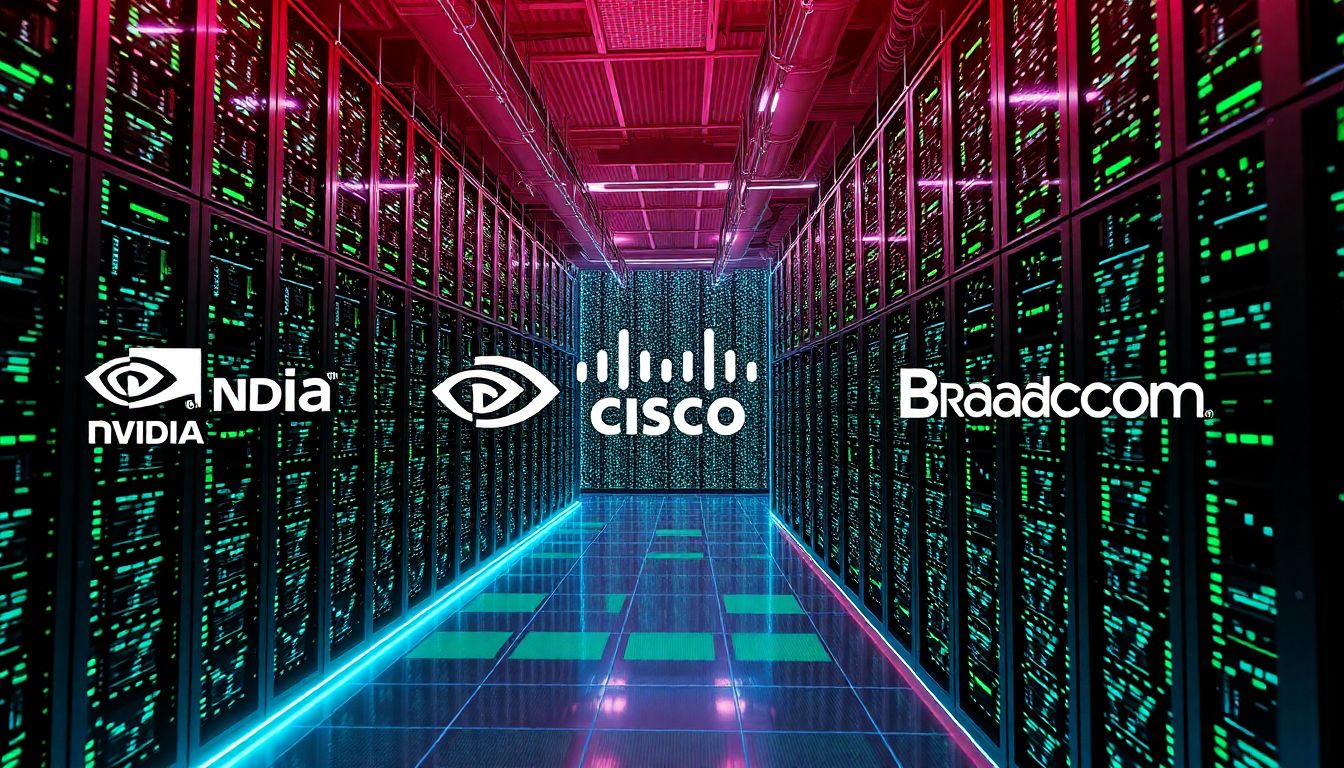
Imagine stepping into a vast, futuristic data center, a sprawling metropolis of digital innovation. The air hums with the quiet, efficient whisper of thousands upon thousands of interconnected processors, each a tiny city of silicon and circuitry. The sheer scale of the place is breathtaking; it’s a cathedral of technology, a testament to humanity’s relentless pursuit of progress.
As you walk through the meticulously organized racks, you notice the prominent logos etched onto the hardware: Nvidia’s eye-like design, Cisco’s iconic golden bridge, Broadcom’s bold and simple waves. These emblems are not just logos; they are symbols of technological prowess, signifying the cutting-edge advancements that drive our connected world.
Looking closer, you see the intricate dance of data, a ballet of ones and zeros pulsating through the labyrinthine network. This is not just a data center; it’s a living, breathing digital organism. It’s a place where the future is forged, one calculation at a time, powered by the relentless innovation of these silicon titans. The logos of Nvidia, Cisco, Broadcom, and other networking companies are not just stamps of corporate identity; they are beacons of progress, guiding us into the next era of technological evolution.
The Rise of AI Networks
In the realm of artificial intelligence, advanced networking technology plays an indispensable role in the efficient functioning and scalability of AI systems. As AI models become increasingly complex and data-intensive, the need for high-bandwidth, low-latency networks has never been more pronounced. Advanced networking ensures that AI clusters can handle the vast amounts of data and processing power required for tasks such as training deep learning models and real-time data analysis.
Several key players in the technology industry have emerged as essential enablers of large-scale AI clusters. Companies like Nvidia, Broadcom, and Cisco are at the forefront of this technological revolution, each contributing unique and critical components to the AI ecosystem. Nvidia, renowned for its powerful GPUs, provides the computational horsepower necessary for AI workloads. Broadcom, with its expertise in semiconductors and networking hardware, delivers the high-speed connectivity solutions that facilitate data transfer within AI clusters. Cisco, a networking giant, offers robust infrastructure and software-defined networking (SDN) solutions that ensure the reliability and scalability of AI networks.
The synergy between these companies creates an environment where AI can thrive. Here’s how they complement each other:
- Nvidia: Offers specialized hardware like GPUs and DPUs that accelerate AI computations, enabling faster model training and inference.
- Broadcom: Provides advanced switching and routing solutions that ensure low-latency and high-throughput data transfer, critical for distributed AI systems.
- Cisco: Delivers comprehensive networking infrastructure and management tools, ensuring the seamless operation and scalability of AI clusters.
Without these foundational technologies, the development and deployment of AI at scale would be significantly hindered, underscoring the importance of advanced networking in the AI landscape.

Key Players in the AI Networking Game
In the realm of AI data centers, several key players have emerged as providers of essential infrastructure. Chief among them is Broadcom, a company renowned for its semiconductor products and infrastructure software solutions. Broadcom’s offerings, including high-speed switches and network processors, are pivotal for the efficient transfer and processing of data in AI workloads. The company’s recent stock performance has been notable, with a steady incline in the past year, reflecting investor confidence in its strategic positioning. Looking ahead, Broadcom’s future prospects appear promising, given its continued innovation and acquisitions that bolster its portfolio.
Cisco, another titan in the industry, is instrumental in providing the networking hardware, software, and telecommunications equipment necessary for AI data centers. Cisco’s robust product line, including its Nexus data center switches and Application Centric Infrastructure (ACI), facilitates the high bandwidth and low latency required for AI operations. Despite some fluctuations, Cisco’s stock has shown resilience and growth, buoyed by its strong market presence and diverse product offerings. The company’s future prospects are encouraging, with a focus on subscription-based services and the integration of AI and machine learning into its products.
Alongside these giants, Arista Networks and Marvell Technology play crucial roles in AI data center infrastructure. Arista Networks specializes in software-driven cloud networking solutions for large data center storage and computing environments. The company’s stock has seen significant gains, driven by its strong performance in the cloud networking market. Arista’s future prospects are bright, with a growing demand for its high-speed, low-latency networks. Marvell Technology, on the other hand, provides semiconductor products, including processors and controllers, that are vital for data storage, networking, and connectivity in AI data centers. Marvell’s stock performance has been positive, with a notable increase in the past year. The company’s future prospects look promising, given its strategic investments in 5G and AI technologies.

The Future of AI Networking
The landscape of AI networking is witnessing a significant shift with two emerging trends: the transition from InfiniBand to Ethernet and the increasing adoption of fiber optic connections. While InfiniBand has traditionally been favored for its low latency and high bandwidth, Ethernet is rapidly catching up with advancements such as RoCE (RDMA over Converged Ethernet). Ethernet’s ubiquity and cost-effectiveness make it an attractive alternative, especially as it begins to support the high-performance computing needs of AI workloads.
The shift towards Ethernet is not the only change afoot. Fiber optic connections are becoming increasingly prevalent, offering unparalleled data transmission speeds and distance capabilities. This is crucial for AI applications that require rapid data transfer and processing. The combination of Ethernet and fiber optics is set to revolutionize AI networking, enabling more efficient and scalable data centers.
The potential market growth for these technologies is substantial. According to industry reports, the global AI market size is expected to reach hundreds of billions of dollars by the end of this decade, with a significant portion dedicated to infrastructure. Companies poised to benefit from this trend include:
- Nvidia: A leader in AI accelerators, Nvidia is well-positioned to capitalize on the growing demand for high-performance networking.
- Mellanox (now a part of Nvidia): Known for its high-speed interconnect solutions, Mellanox’s Ethernet and InfiniBand products are crucial for AI networking.
- Cisco: A networking giant, Cisco’s data center solutions are likely to see increased demand as Ethernet becomes more prevalent in AI workloads.
- Corning: Specializing in fiber optic technologies, Corning stands to benefit from the increasing use of fiber optics in data centers.
